
BUDDY, THE GRAVEDIGGER
15,000 Graves: Life as a Third-Generation West Virginia Gravedigger

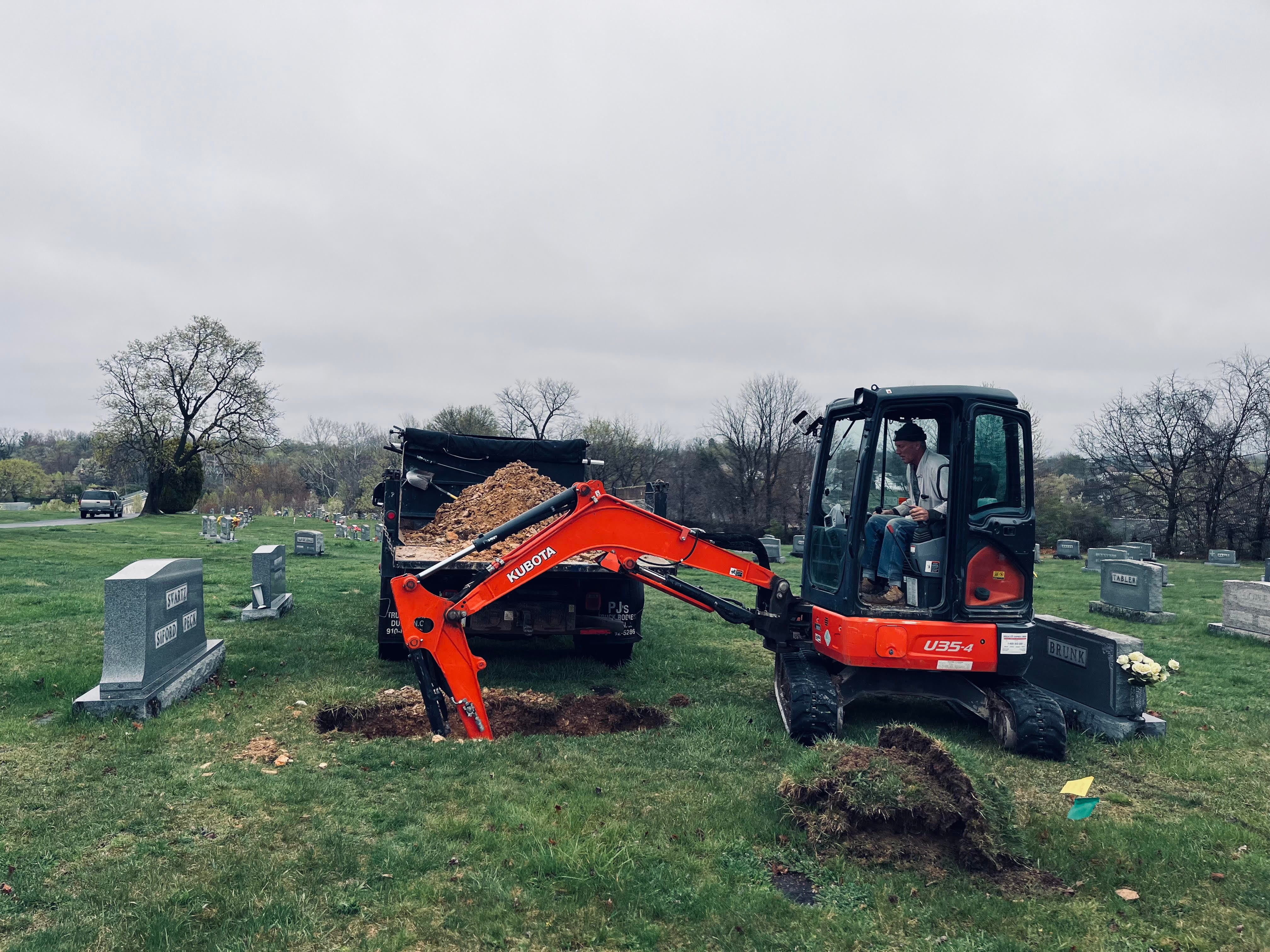
Buddy scooped the rainwater out of the fresh grave with the same excavator bucket he used to dig the hole. It’d been raining for days and the grave was at the bottom of a hill, so the hole kept flooding. He and his employee, George, had a few hours to keep the water out of the grave before the funeral. This was at the far edge of the cemetery, near where the house with the pig in the yard gets aggressive whenever he hears George come through with the mower.
Buddy is a third-generation gravedigger in the panhandle of West Virginia.
“I was born with a shovel in my hands,” he said.
I typically sit by Buddy in church. When he’s not digging graves, he likes to work on the church. It’s an old church, and he takes pride in its care. There are a few gravestones in the yard, and he’s dug one of those as well.
Our small congregation has breakfast together in the church kitchen after service on the first Sunday of every month. The first time we met he told me he was a gravedigger and I told him I was a hearse driver’s grandson.
Buddy’s been digging graves for over forty years. His son is his partner, maintaining the property, and his daughter is the undertaker.
He grew up in a cemetery about ten minutes away. They lived in the old house behind a black wrought-iron cemetery fence across from the elementary school.
“No one wanted to come play hide and seek at my house,” Buddy said with a laugh.
Buddy was twelve when he dug his first grave. “My dad was a little man, about 5’5,” he recalls. “He lost his leg in a sand mine and had a wood peg from the knee down. Smoked cigars all the time. He managed the cemeteries, but he had us boys dig the graves.” His father dropped his three sons out at one of the cemeteries in Harpers Ferry and told them to dig three holes, one for each victim of a recent fire.
Buddy’s family has earned a reputation for gravedigging. They dig fast, and they’re efficient.
“Everyone knows us because we’re good at doing the dirty jobs,” Buddy said—as he leaned over into the grave to see how much water was left.
It took four years after digging his first grave to understand what a dirty job looked like. They drove down to Winchester, Virginia, for a transport job — that’s where you have to exhume a body and move it elsewhere. A lot of times in this area gravediggers are transporting bodies because people are selling their farm, and having the family plots on the land decreases the value.
This was back when they were still working by hand only, with shovels and picks. When they got down to the casket, it was a simple wooden box, and it had begun to rot. The farmer inside the box was wrapped in a sheet. He’d been dead a year. But there was nothing to hold onto to get him out. Buddy asked his brother what they were going to do. His brother said “Go grab some ropes in the truck.” The plan was to wrap him up in the ropes and hoist him out. The undertaker stood at the top of the grave observing the young men working within it. Their eyes just about at the level with the undertaker’s shoes. They started tossing pieces of the rotten casket out of the grave. Buddy made sure not to look at the farmer. Then they laid a rake across the body and wrapped the ropes around and handed the ropes to the undertaker. He was supposed to pull as the boys pushed. The undertaker was about 65, so Buddy assumed the man had seen everything.
“But about halfway up out of the hole, the farmer starts falling apart and the undertaker starts running,” Buddy said. “And so did I.”
Buddy jumped out of the grave and his brother was down in the hole yelling, “Come back!” To this day, Buddy doesn’t know how his brother got the whole body out. But they’ve encountered worse since. He and George have memories of certain bodies that might not have been found right away. These memories make them feel like there are bugs crawling on their clothes.
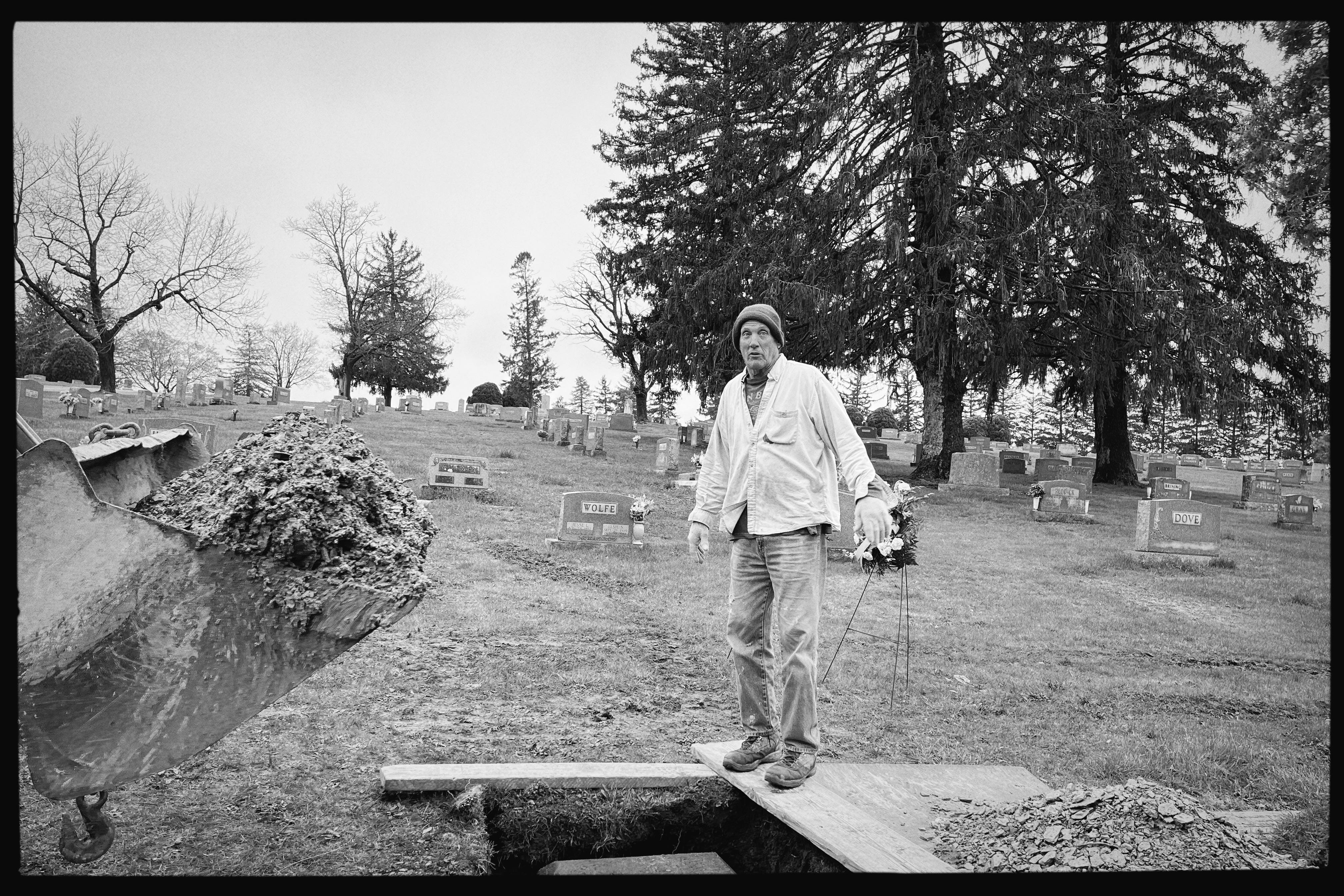
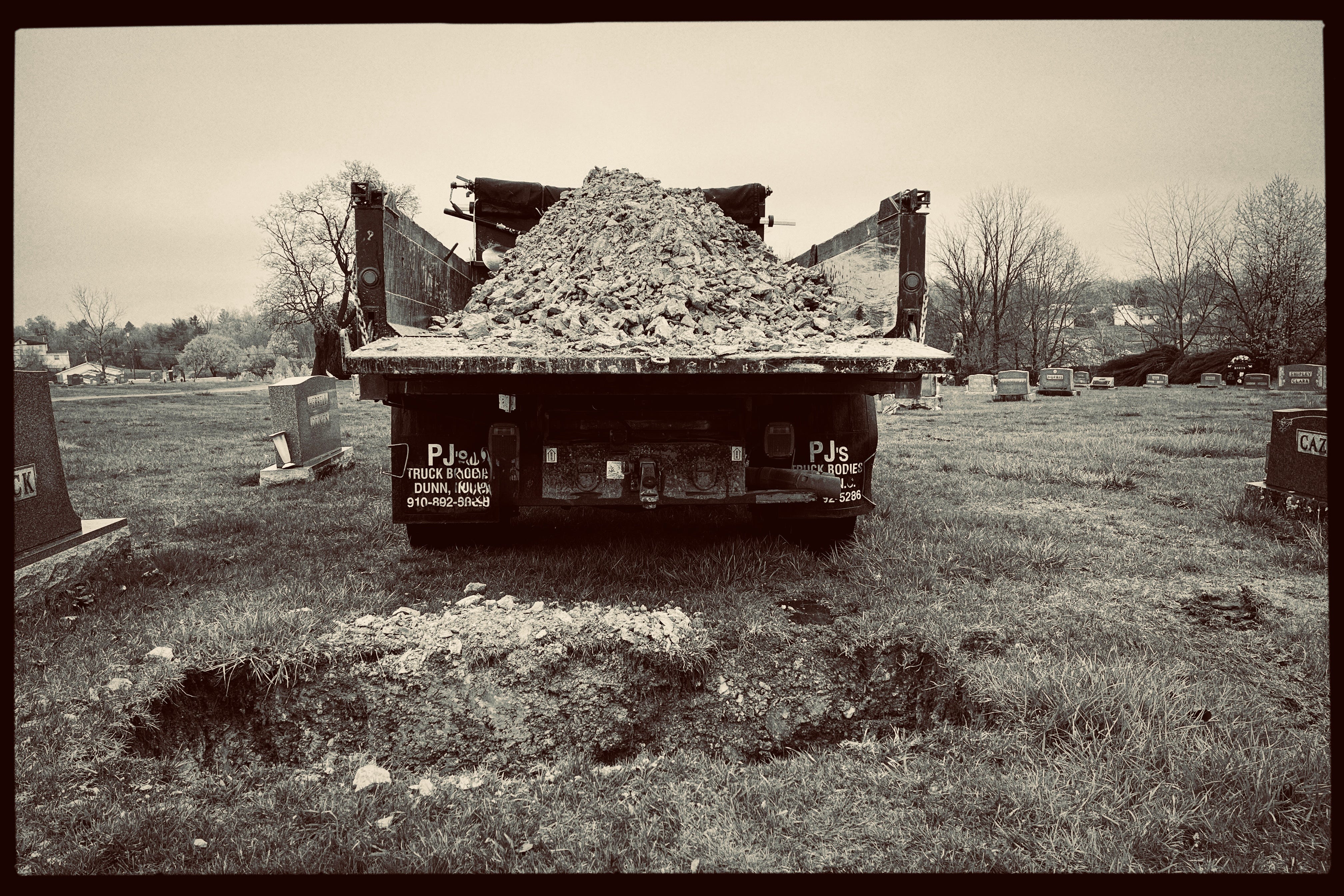
The rain’s stopped and this fresh grave’s empty enough for Buddy to lower the 2000 lb vault into the hole. This cemetery requires every casket be put in large waterproof vaults. Once the vault is in the ground, he and George lay wood across the edges of the grave that supports the pulley system used to lower the casket. George unrolls bright green turf around the grave and under the red tent where the friends and family will sit.
There’s a pine just up a bit to the left of this grave where George is always finding syringes because the junkies come in here and shoot up where no one can see them. There’ve also been times where he’s had to chase out hookers who were in cars with their Johns by the far edge of the cemetery.
And then there was that time on Mother’s Day when in the morning a woman walked up with her dog and said there’s a casket sticking out the mausoleum. Buddy thought she was a crazy person. But then a second person said the same thing. They inspected the situation and found out it was a grave robbery. Some junkies had pried open twenty mausoleums with a crowbar and reached their hands into the caskets to pull off any jewelry. The thieves hadn’t thought through the crime enough to know that they left muddy fingerprints on the white mausoleums and on Mountain Dew bottles. The police traced the jewelry to a kiosk in a nearby mall.
Buddy prepared the grave for the funeral and remembered how he’d moved entire graveyards, lawfully, from one place to another so construction could happen. He thought about the time he exhumed a body for an investigation and the police took the hands and Buddy reburied the man without his hands. He thought about all the limbs he’d come across discarded in piles from Civil War battlefields.
He’s on call every day of the week.
“Like a fireman,” he said, “if there’s a fire, you go put out the fire…”
He could hear the water begin to spill in from the bottom of the grave and splash against the vault. The funeral wasn’t for another two hours.
*
After the water was removed from the first grave, there were two more graves to dig. One for a casket, one for an urn with the remains of a husband and wife who’d been dead for some years and kept on their daughter’s mantle.
I carried the ashes of the Funks, husband and wife, and placed them on top of the grave. We put up another red tent and rolled out the turf and set up a few chairs. There were mean geese patrolling the wet grass.
We drove to the top of another hill to dig the second grave. “See that flower there on top of the stone?” Buddy asked. “That’s my uncle.” Then he pointed to other headstones and showed me more family members. Most of them were also in the funeral business.
The year 1992 is etched in Buddy’s memory the way these epitaphs are etched into the stone. It’s the year that he switched from digging graves by hand to digging them with what he calls “the machine.”
Ever since he got the hang of the excavator, it takes him fifteen minutes to dig a grave.
George calls Buddy “The Legend” because of how fast and clean he can dig a grave just by eyesight. Not everyone can maneuver the machine the way Buddy can, George told me.
Buddy opened the ground for the next grave. This was a husband joining his wife tomorrow. She’d been buried about ten years prior.
Just as Buddy scooped up the first pile of dirt, he yelled out over the engine.
“You see the different color soil?” he asked. “You’re never gonna put it back the way God had it.”
The more he dug, he revealed the side of the wife’s vault. And you could see the distinctly lighter soil that was disturbed for her funeral a decade ago. The new grave was all black dirt and shale.
The bucket scraped gently against the wife’s vault.
“Any closer and you’ll be waking them up,” George said.
Buddy jumped out of the machine and walked the edge of the grave to ensure it was seven feet long.
Buddy’s son saw me walking by the fresh grave and joked, “I was concerned because I thought my dad buried someone in the wrong spot again…”
I asked Buddy if he had a plot picked out for himself. He pointed out a plot at the top of a hill between the flagpole and the big line of tall pines. “My stone’s paid for already,” he said, pointing to his and his wife’s future headstone. “The grave digging is already paid for too.”
It was important to find a plot away from any water because his wife does not want to be buried in water.
“There’s cats and dogs right down there in the pine trees. There’s even a monkey. That monkey had a bigger funeral than the one you’ll see today. He had about 30 cars in his funeral procession.”
Buddy asked me to pull what he called the “grave-finding probe” out from the back of the flatbed. It’s a long steel pole with a handle that you pump to drive the pole down through the dirt. Then he asked me to drive the prod into the dirt in front of an old headstone. I pumped the handle and then heard the loud hollow clink below.
“Hear that? Top of the vault,” he said. “Now put it between the graves. The prod went down at least six feet, and no sound, just dirt.
As I yanked the prod out of the ground, a man drove past in the rain to say hi to Buddy. He had a Jamaican accent. He’d come to put flowers on his wife’s grave.
“Six years today that my wife was buried,” he said.
“Time flies,” Buddy said with a low and sad tone.
When the man drove off, Buddy told me that the man has two grandchildren buried up there too.
“Has this changed the way you view death?” I asked.
“No,” he said. He has no fear of death. And he cares about giving everyone a proper send-off. “I don’t care if you’re rich or poor. I respect the dead. I just want to take care of people.” He’s seen rookie gravediggers crack caskets, bury caskets upside down. On a few occasions people have been buried and exhumed immediately because the undertaker supposedly forgot to take jewelry off the dead. The only undertaker Buddy trusts is his daughter.
*
We had to pump out more water from this morning’s grave one last time before the white hearse drove slowly down the hill and parked beside the grave. Buddy and I stood near the top of the hill. George helped the pallbearers with the casket. Buddy’s daughter, the undertaker, arrived with the hearse.
“Watch her tap her head and point to the grave to make sure George knows where the head needs to be placed in the grave.”
Buddy is always careful to make sure the dead are placed in the position they asked. Headstones have to face a certain way, he explains, but you can choose to lie in whichever direction you like.
He told me about a woman who was having nightmares because she believed her husband was buried in the wrong direction. She called the funeral home at this other cemetery an hour from Buddy’s. It was important for her husband to be buried with his head facing a certain way. In her nightmares, she saw the hinges of the casket closest to his head being lowered where his feet supposedly were. She learned that the undertaker never relayed the message of her husband’s wishes to the gravediggers. Her nightmares were showing her the truth. After lots of phone calls denying her the chance to fix the problem, they got to Buddy—who made it right.
Once today’s funeral was over, and everyone left, it was just me, Buddy, his daughter, George, and the preacher—and the casket. The rainwater had filled the grave again, and the vault with the casket was floating at the surface.
“It’s full of water again,” Buddy’s daughter said.
Buddy dropped the lid on the vault with the excavator — making it about 3000 lbs.
“It might roll over,” she said.
“It’s not rollin’ over,” Buddy said. She’d seen a casket roll over in a flooded grave before, but Buddy said he digs graves just wide enough to fit the casket without any room for flipping.
Buddy asked his daughter about some unclaimed remains that the State was holding onto down in Charleston. He wondered how many cremains the state must have in storage.
“I think they do mass cremations,” his daughter said.
“I don’t agree with putting them all in the same pile,” Buddy said.
“The Lord will sort it out,” the preacher said—an older man in extra-wide suit pants and a large jacket, and a massive Bible in his hands.
There was a moment of silence as the casket made its way to the bottom.
“How many graves do you think you’ve dug in your life?” I asked Buddy.
“Well, I average about 200 a year since I started here in 2004.” He estimates around 4,000 graves in this cemetery alone. But then he said there’s been, at least, on average, one a day since he started digging. That puts him somewhere north of 15,000—though that’s most likely a conservative number.
“This job isn’t for everyone,” Buddy said as George lowered the casket. “Years back, we had one kid that’d walk a mile to my dad’s porch begging for a job. Eventually, my dad said alright. This was back when we were digging ‘em by hand. Three shovels. Two picks. The kid asked, ‘Where’s the excavator?’ I threw him the shovel and said, ‘Right here.’” That boy didn’t last long.
“Everybody wants something better,” Buddy said. George had begun to roll up the turf and put away the chairs. “And there is something better. It’s just a matter of getting it.” Like that time he dug a hole for a woman’s father and the woman watched, then asked if she could lay down in the grave to see what her father’s view would be. He was happy to oblige.
Brilliant as always, Shane!
interesting.. this is a very hard job to do even with the excavater! Nice to know he cares about the people he's burying and their families wishes.